Prime numbers 1 to 500
Prime numbers are special numbers in mathematics that have exactly two factors: 1 and themselves. They cannot be divided evenly by any other number.
Prime numbers are the building blocks of all natural numbers because every composite number can be expressed as a product of prime numbers.
What Is a Prime Number?
A prime number is a natural number greater than 1 that has only two positive factors:
- 1
- The number itself
For example:
- 2 is a prime number because its factors are 1 and 2.
- 5 is a prime number because its factors are 1 and 5.
- 7 is a prime number because its factors are 1 and 7.
Is 1 a Prime Number?
No, 1 is not a prime number.
A prime number must have exactly two distinct factors. The number 1 has only one factor, which is itself.
List of Prime Numbers from 1 to 500
2, 3, 5, 7, 11, 13, 17, 19, 23, 29
31, 37, 41, 43, 47, 53, 59, 61, 67, 71
73, 79, 83, 89, 97, 101, 103, 107, 109, 113
127, 131, 137, 139, 149, 151, 157, 163, 167, 173
179, 181, 191, 193, 197, 199, 211, 223, 227, 229
233, 239, 241, 251, 257, 263, 269, 271, 277, 281
283, 293, 307, 311, 313, 317, 331, 337, 347, 349
353, 359, 367, 373, 379, 383, 389, 397, 401, 409
419, 421, 431, 433, 439, 443, 449, 457, 461, 463
467, 479, 487, 491, 499
Total Prime Numbers from 1 to 500
There are 95 prime numbers between 1 and 500.
Smallest and Largest Prime Numbers in This Range
- Smallest Prime Number: 2
- Largest Prime Number Between 1 and 500: 499
Properties of Prime Numbers
1. A Prime Number Has Exactly Two Factors
For example:
- Factors of 13 = 1, 13
- Factors of 29 = 1, 29
2. 2 Is the Only Even Prime Number
All other even numbers are divisible by 2 and therefore are not prime.
3. Every Composite Number Can Be Written Using Prime Factors
Example:
60 = 2 × 2 × 3 × 5
4. Prime Numbers Continue Forever
There is no largest prime number. New prime numbers continue indefinitely.
Importance of Prime Numbers
Prime numbers are important because they:
- Form the foundation of number theory
- Help in finding factors and multiples
- Are used in computer algorithms
- Play a major role in cryptography and internet security
- Help solve mathematical problems efficiently
Examples of Prime and Composite Numbers
Prime Numbers
2, 3, 5, 7, 11, 13, 17, 19
Composite Numbers
4, 6, 8, 9, 10, 12, 14, 15
Composite numbers have more than two factors.
How to Identify a Prime Number
A number is prime if:
- It is greater than 1
- It is divisible only by 1 and itself
Example:
17
Factors of 17:
1, 17
Since it has only two factors, it is prime.
Example:
18
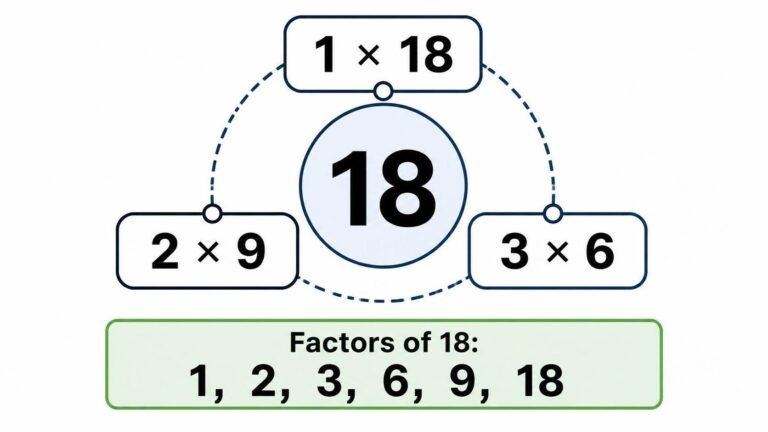
Factors of 18:
1, 2, 3, 6, 9, 18
Since it has more than two factors, it is composite.
FAQs
What are prime numbers?
Prime numbers are numbers greater than 1 that have exactly two factors: 1 and themselves.
Is 1 a prime number?
No, 1 is neither a prime number nor a composite number.
What is the first prime number?
2 is the first and smallest prime number.
How many prime numbers are there between 1 and 500?
There are 95 prime numbers between 1 and 500.
What is the largest prime number under 500?
499 is the largest prime number less than 500.
Why is 2 special among prime numbers?
2 is the only even prime number.
Is 97 a prime number?
Yes, 97 is a prime number because it has only two factors: 1 and 97.
Is 121 a prime number?
No, 121 = 11 × 11, so it is a composite number.
Are all odd numbers prime?
No. Many odd numbers such as 9, 15, and 21 are composite.
Why are prime numbers important?
Prime numbers are used in mathematics, cryptography, computer science, and many real-world applications.