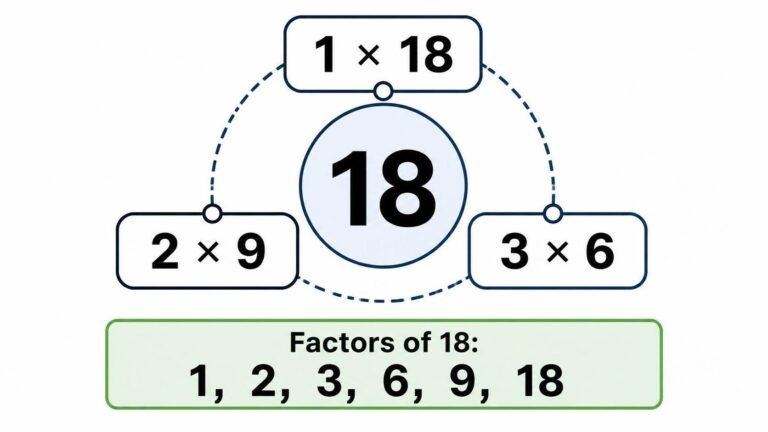
How to Find Factors of a Big Number
Finding factors of a big number can seem difficult at first, but with the right methods, it becomes simple and systematic. Factors are numbers that divide a given number completely without leaving any remainder.
In this article, you will learn easy techniques to find factors of large numbers step by step, along with examples and tips.
What Are Factors?
Factors are numbers that divide another number exactly.
For example:
- Factors of 12 are 1, 2, 3, 4, 6, 12
Because all these numbers divide 12 without leaving a remainder.
Why Finding Factors of Big Numbers Is Important
Finding factors is useful in:
- Simplifying fractions
- Finding HCF (Highest Common Factor)
- Finding LCM (Least Common Multiple)
- Solving algebra problems
- Number theory and coding problems
Method 1: Division Method
This is the simplest method.
Steps:
- Start dividing the number by 1, 2, 3, 4, 5, and so on
- Check which divisions give zero remainder
- Each divisor is a factor
Example: Find factors of 48
- 48 ÷ 1 = 48
- 48 ÷ 2 = 24
- 48 ÷ 3 = 16
- 48 ÷ 4 = 12
- 48 ÷ 6 = 8
- 48 ÷ 8 = 6
- 48 ÷ 12 = 4
- 48 ÷ 16 = 3
- 48 ÷ 24 = 2
- 48 ÷ 48 = 1
So factors are:
1, 2, 3, 4, 6, 8, 12, 16, 24, 48
Method 2: Prime Factorization Method
This method is very useful for big numbers.
Steps:
- Break the number into prime factors
- Multiply combinations of these prime factors
- List all possible results
Example: Find factors of 72
Prime factorization:
72 = 2 × 2 × 2 × 3 × 3 = 2³ × 3²
Now combine:
Factors of 72 are:
1, 2, 3, 4, 6, 8, 9, 12, 18, 24, 36, 72
Method 3: Factor Tree Method
A factor tree helps break numbers step by step.
Example: 90
90
→ 9 × 10
→ (3 × 3) × (2 × 5)
So:
90 = 2 × 3 × 3 × 5
Now generate factors using combinations.
Method 4: Pair Method
Factors come in pairs.
Example: 100
- 1 × 100
- 2 × 50
- 4 × 25
- 5 × 20
- 10 × 10
So factors are:
1, 2, 4, 5, 10, 20, 25, 50, 100
Tips for Finding Factors of Big Numbers
- Always start with small primes (2, 3, 5, 7, 11)
- Use divisibility rules
- Stop checking after √n (square root rule)
- Use prime factorization for large numbers
- Look for factor pairs instead of random guessing
Square Root Trick (Very Important)
You only need to check numbers up to the square root of a number.
Example:
For 1000 → √1000 ≈ 31.6
So you only check numbers up to 31.
This saves a lot of time.
Common Mistakes to Avoid
- Skipping prime numbers
- Not checking factor pairs
- Going beyond square root unnecessarily
- Forgetting 1 and the number itself
Real-Life Uses of Factors
- Sharing items equally
- Dividing groups
- Designing layouts
- Programming and encryption
- Engineering calculations
FAQs
What is a factor of a number?
A factor is a number that divides another number completely without remainder.
How do you find factors of a big number quickly?
Use prime factorization or check divisibility up to the square root.
What is the fastest method to find factors?
Prime factorization combined with factor pairing is the fastest method.
Why do we stop at square root?
Because factors repeat after the square root point.
Are all numbers divisible by 1?
Yes, 1 is a factor of every number.
What is the difference between factors and multiples?
Factors divide a number, while multiples are results of multiplying a number.