Prime numbers and composite numbers
In mathematics, numbers are mainly divided into two important categories: prime numbers and composite numbers. Understanding these two types of numbers helps in learning factors, multiplication, division, HCF, LCM, and many other concepts.
This article explains both types of numbers in detail with examples, properties, and differences.
What Are Prime Numbers?
A prime number is a natural number greater than 1 that has exactly two factors:
- 1
- The number itself
Examples of Prime Numbers
2, 3, 5, 7, 11, 13, 17, 19, 23, 29, 31, 37, 41, 43, 47…
Key Point
- 2 is the only even prime number
- All other even numbers are composite
What Are Composite Numbers?
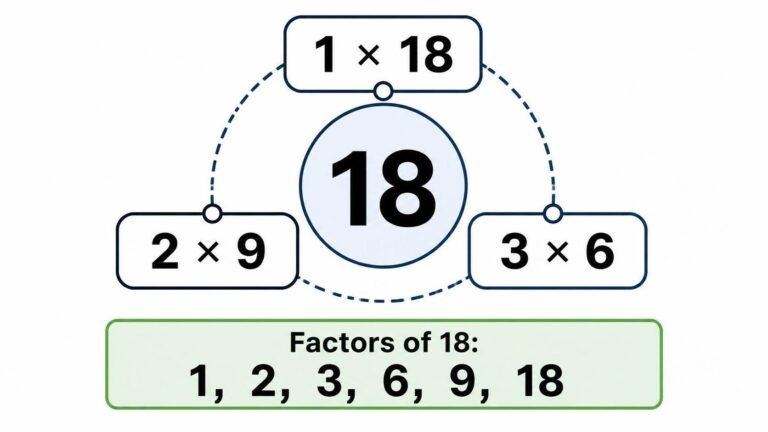
A composite number is a natural number greater than 1 that has more than two factors.
In simple words, composite numbers can be divided evenly by numbers other than 1 and themselves.
Examples of Composite Numbers
4, 6, 8, 9, 10, 12, 14, 15, 16, 18, 20, 21, 22, 24…
Example Explanation
- 6 → factors are 1, 2, 3, 6 → composite
- 9 → factors are 1, 3, 9 → composite
- 12 → factors are 1, 2, 3, 4, 6, 12 → composite
Special Case: Number 1
The number 1 is neither prime nor composite because it has only one factor (itself).
Difference Between Prime and Composite Numbers
Prime Numbers
- Have exactly 2 factors
- Only divisible by 1 and itself
- Example: 2, 3, 5, 7, 11
Composite Numbers
- Have more than 2 factors
- Can be divided by numbers other than 1 and itself
- Example: 4, 6, 8, 9, 10
How to Identify Prime and Composite Numbers
To determine whether a number is prime or composite:
- Check if the number is greater than 1
- Find all possible divisors
- Count the number of factors
- If only 2 factors → Prime
- If more than 2 factors → Composite
Example 1
Is 13 prime or composite?
- Factors of 13: 1, 13
- Only 2 factors → Prime number
Example 2
Is 15 prime or composite?
- Factors of 15: 1, 3, 5, 15
- More than 2 factors → Composite number
Properties of Prime Numbers
- Always greater than 1
- Have exactly two factors
- Cannot be divided evenly except by 1 and itself
- Infinite in number
Properties of Composite Numbers
- Always greater than 1
- Have more than two factors
- Can be expressed as a product of prime numbers
- Most numbers in mathematics are composite
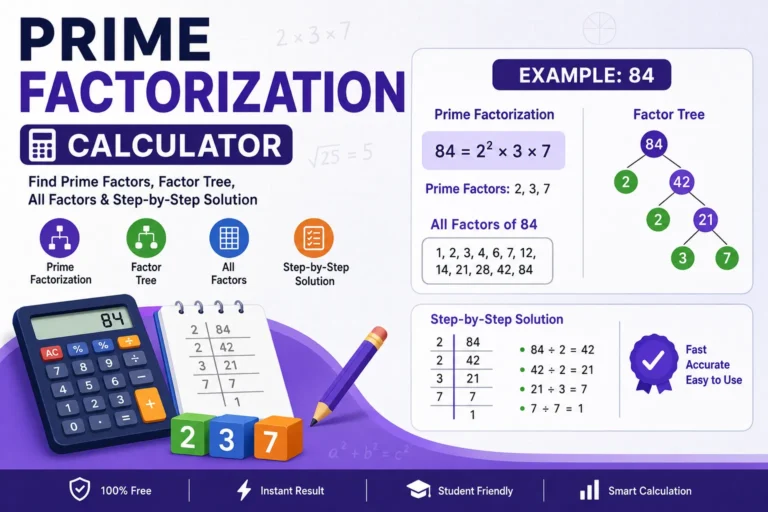
Prime Factorization
Every composite number can be written as a product of prime numbers.
Example:
12 = 2 × 2 × 3
18 = 2 × 3 × 3
20 = 2 × 2 × 5
Importance of Prime and Composite Numbers
These numbers are important in:
- Mathematics learning
- Factorization problems
- HCF and LCM calculations
- Algebra
- Computer science and cryptography
FAQs
What are prime numbers?
Prime numbers are numbers greater than 1 that have exactly two factors: 1 and themselves.
What are composite numbers?
Composite numbers are numbers greater than 1 that have more than two factors.
Is 1 a prime or composite number?
1 is neither prime nor composite.
What is the smallest prime number?
The smallest prime number is 2.
What is the smallest composite number?
The smallest composite number is 4.
Is 2 a composite number?
No, 2 is a prime number because it has only two factors: 1 and 2.
Why is 9 a composite number?
Because it has more than two factors: 1, 3, and 9.
Can a number be both prime and composite?
No, a number cannot be both. It is either prime or composite (except 1).
Why are prime numbers important?
They are used in mathematics, encryption, computer algorithms, and number theory.