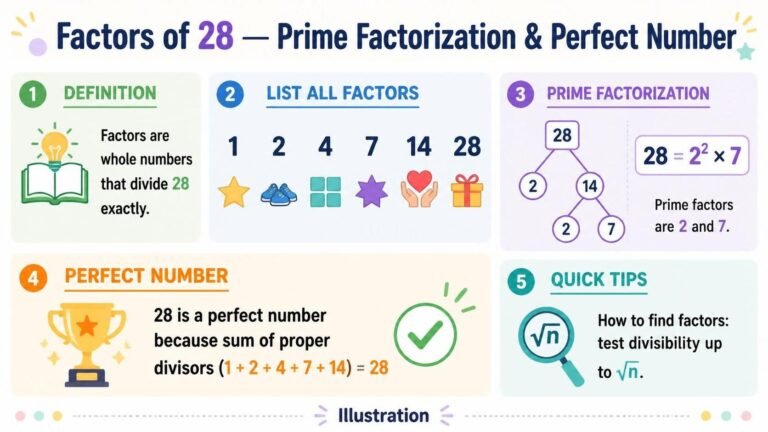
Factors of 38
The factors of 38 are the numbers that divide 38 exactly without leaving any remainder. Understanding factors is an important part of mathematics because it helps students learn multiplication, division, prime numbers, and factorization.
In this detailed guide, we will explore the factors of 38, factor pairs, prime factorization, and practical examples to make the concept easy to understand.
What Are Factors?
Factors are whole numbers that can divide another number completely. When a number is divided by its factor, the remainder is always zero.
For example, if 38 is divided by 2:
38 ÷ 2 = 19
Since there is no remainder, 2 is a factor of 38.
Factors of 38
To find the factors of 38, we check which numbers divide 38 exactly.
The factors of 38 are:
1, 2, 19, and 38
These are the only positive integers that divide 38 without leaving a remainder.
How to Find the Factors of 38
Let’s test different numbers:
- 38 ÷ 1 = 38 ✓
- 38 ÷ 2 = 19 ✓
- 38 ÷ 3 = 12.67 ✗
- 38 ÷ 4 = 9.5 ✗
- 38 ÷ 5 = 7.6 ✗
- 38 ÷ 19 = 2 ✓
- 38 ÷ 38 = 1 ✓
Therefore, the factors of 38 are:
1, 2, 19, 38
Factor Pairs of 38
Factor pairs are two numbers that multiply together to produce 38.
The factor pairs of 38 are:
- 1 × 38 = 38
- 2 × 19 = 38
So, the factor pairs of 38 are:
(1, 38)
(2, 19)
Prime Factorization of 38
Prime factorization means expressing a number as a product of prime numbers.
Step 1: Divide 38 by the smallest prime number, which is 2.
38 ÷ 2 = 19
Step 2: Check 19.
19 is a prime number because it has only two factors: 1 and 19.
Therefore:
38 = 2 × 19
Prime factorization of 38:
2 × 19
Or written in exponential form:
2¹ × 19¹
Is 38 a Prime Number?
No, 38 is not a prime number.
A prime number has exactly two factors: 1 and itself.
Since 38 has four factors (1, 2, 19, and 38), it is a composite number.
Is 38 an Even Number?
Yes, 38 is an even number.
Any number ending in 0, 2, 4, 6, or 8 is even.
Since 38 ends with 8, it is divisible by 2.
Common Multiples and Factors
Factors help us understand divisibility and multiplication relationships.
For example:
- Factors of 38: 1, 2, 19, 38
- Multiples of 38: 38, 76, 114, 152, 190, and so on
Factors are finite, while multiples continue indefinitely.
Real-Life Importance of Factors
Factors are useful in many mathematical applications, including:
- Simplifying fractions
- Finding common factors
- Solving algebraic equations
- Understanding divisibility rules
- Calculating dimensions and measurements
Students often use factors when solving problems involving grouping, sharing, and arranging objects.
Examples
Example 1
Is 19 a factor of 38?
38 ÷ 19 = 2
Since the remainder is 0, 19 is a factor of 38.
Example 2
Is 5 a factor of 38?
38 ÷ 5 = 7.6
Since the result is not a whole number, 5 is not a factor of 38.
Example 3
Find a factor pair of 38.
2 × 19 = 38
Therefore, (2, 19) is a factor pair of 38.
Summary
The factors of 38 are 1, 2, 19, and 38. These numbers divide 38 exactly without leaving a remainder. The factor pairs of 38 are (1, 38) and (2, 19). The prime factorization of 38 is 2 × 19. Since it has more than two factors, 38 is a composite number and not a prime number.
Frequently Asked Questions (FAQs)
What are the factors of 38?
The factors of 38 are:
1, 2, 19, and 38.
How many factors does 38 have?
38 has 4 factors:
1, 2, 19, and 38.
What are the factor pairs of 38?
The factor pairs of 38 are:
(1, 38) and (2, 19).
What is the prime factorization of 38?
The prime factorization of 38 is:
2 × 19.
Is 38 a prime number?
No, 38 is a composite number because it has more than two factors.
Is 38 divisible by 2?
Yes, 38 is divisible by 2 because it is an even number.
Is 19 a factor of 38?
Yes, 19 is a factor of 38 because 38 ÷ 19 = 2.
What is the greatest factor of 38?
The greatest factor of 38 is 38 itself.
What is the smallest factor of 38?
The smallest factor of 38 is 1.
Why are factors important in mathematics?
Factors help in division, multiplication, simplifying fractions, finding common factors, and solving mathematical problems efficiently.