Prime factor of 36
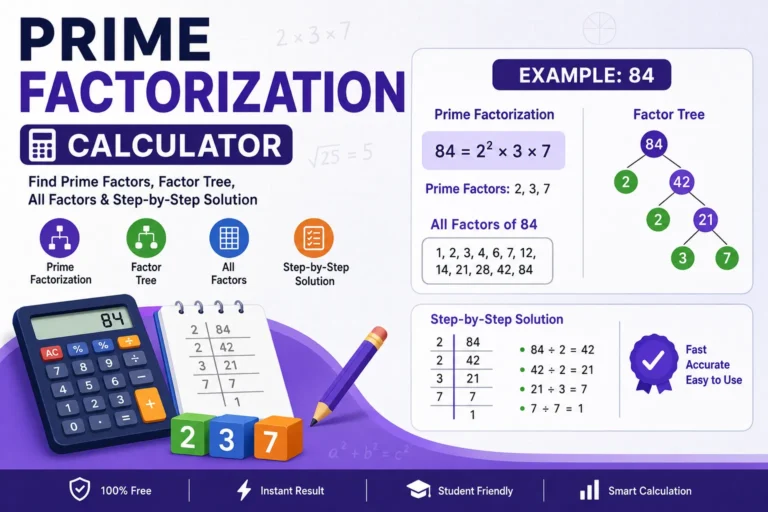
Prime factors of 36 are the prime numbers that multiply together to give 36. Prime factorization is an important concept in mathematics that helps students understand factors, multiples, divisibility, and algebra.
In this article, you will learn the prime factors of 36, how to find them, factor tree methods, examples, and frequently asked questions.
What Are the Prime Factors of 36?
A prime factor is a factor that is also a prime number.
Prime numbers have only two factors: 1 and themselves.
To find the prime factors of 36, divide it by the smallest prime numbers until you reach 1.
Step-by-Step Prime Factorization
36 ÷ 2 = 18
18 ÷ 2 = 9
9 ÷ 3 = 3
3 ÷ 3 = 1
Therefore:
36 = 2 × 2 × 3 × 3
The prime factors of 36 are:
2 and 3
Prime Factorization of 36
The complete prime factorization of 36 is:
36 = 2 × 2 × 3 × 3
Using exponents:
36 = 2² × 3²
This is the standard prime factorization form of 36.
Factor Tree of 36
A factor tree helps break down a number into its prime factors.
Method 1
36
→ 6 × 6
→ (2 × 3) × (2 × 3)
Therefore:
36 = 2 × 2 × 3 × 3
Method 2
36
→ 4 × 9
→ (2 × 2) × (3 × 3)
Therefore:
36 = 2² × 3²
Both methods give the same answer.
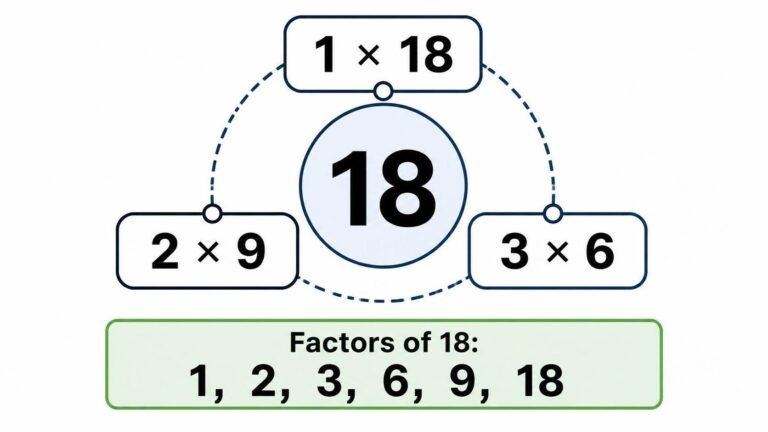
List of Factors of 36
The factors of 36 are:
1, 2, 3, 4, 6, 9, 12, 18, 36
Among these factors, the prime factors are:
2 and 3
Is 36 a Prime Number?
No, 36 is not a prime number.
A prime number has exactly two factors: 1 and itself.
Since 36 has multiple factors, it is a composite number.
How to Find Prime Factors of 36
Follow these simple steps:
Step 1
Divide 36 by the smallest prime number, 2.
36 ÷ 2 = 18
Step 2
Divide 18 by 2 again.
18 ÷ 2 = 9
Step 3
Divide 9 by the next prime number, 3.
9 ÷ 3 = 3
Step 4
Divide 3 by 3.
3 ÷ 3 = 1
Step 5
Write all prime divisors together.
2 × 2 × 3 × 3
Therefore:
36 = 2² × 3²
Solved Examples
Example 1
What are the prime factors of 36?
Prime factorization:
36 = 2 × 2 × 3 × 3
Answer: 2 and 3
Example 2
How many prime factors does 36 have?
Distinct prime factors:
2 and 3
Answer: 2 distinct prime factors
Example 3
What is the product of the prime factors of 36?
2 × 2 × 3 × 3 = 36
Answer: 36
Example 4
Express 36 in exponential prime factor form.
36 = 2² × 3²
Answer: 2² × 3²
Applications of Prime Factorization
Prime factorization is useful for:
- Finding HCF (Highest Common Factor)
- Finding LCM (Least Common Multiple)
- Simplifying fractions
- Solving algebra problems
- Understanding divisibility
- Number theory calculations
Key Points to Remember
- The prime factors of 36 are 2 and 3.
- Prime factorization of 36 is 2² × 3².
- 36 is a composite number.
- A factor tree can be used to find prime factors.
- Prime factorization helps in finding HCF and LCM.
FAQs About Prime Factors of 36
What are the prime factors of 36?
The prime factors of 36 are:
2 and 3
What is the prime factorization of 36?
The prime factorization of 36 is:
2² × 3²
Is 36 a prime number?
No, 36 is a composite number because it has more than two factors.
How many prime factors does 36 have?
36 has 2 distinct prime factors, which are 2 and 3.
What is the factor tree of 36?
One factor tree is:
36 → 6 × 6 → (2 × 3) × (2 × 3)
Therefore:
36 = 2 × 2 × 3 × 3
Why is 2 a prime factor of 36?
Because 36 is divisible by 2 without any remainder.
Why is 3 a prime factor of 36?
Because 36 is divisible by 3 without any remainder.
What is the exponential form of the prime factorization of 36?
2² × 3²
What are the common factors obtained from the prime factorization of 36?
The prime factorization reveals that 2 and 3 are the building blocks of 36 and are used to determine common factors with other numbers.
Conclusion
The prime factors of 36 are 2 and 3. By repeatedly dividing 36 by prime numbers, we get the prime factorization 36 = 2² × 3². Understanding prime factors helps students solve mathematical problems involving factors, multiples, HCF, LCM, and number theory more effectively.