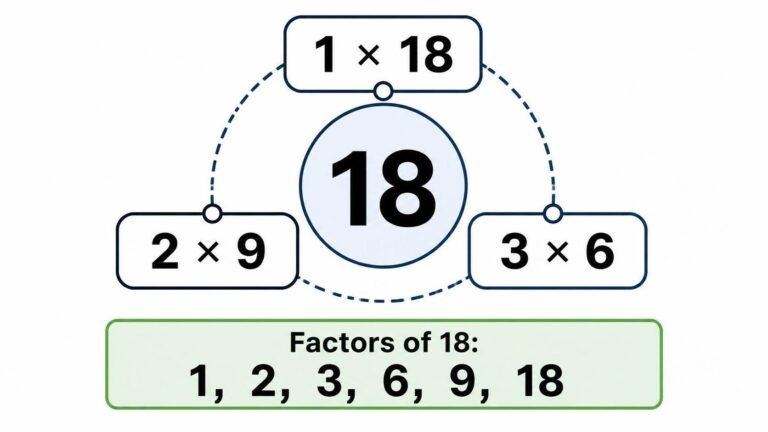
Factors of 14
Factors of 14 are the numbers that divide 14 exactly without leaving a remainder. Understanding factors is an essential mathematical skill that helps students learn multiplication, division, prime numbers, and factorization.
In this article, you will learn the factors of 14, factor pairs, prime factorization, solved examples, and frequently asked questions.
What Are the Factors of 14?
A factor is a whole number that divides another number completely without leaving any remainder.
To find the factors of 14, we check which numbers divide 14 evenly.
Division Method
- 14 ÷ 1 = 14
- 14 ÷ 2 = 7
- 14 ÷ 7 = 2
- 14 ÷ 14 = 1
Since these divisions leave no remainder, the factors of 14 are:
1, 2, 7, and 14
List of Factors of 14
The complete list of positive factors of 14 is:
1, 2, 7, 14
These are the only positive integers that divide 14 exactly.
Factor Pairs of 14
Factor pairs are two numbers that multiply together to produce 14.
Positive Factor Pairs
- 1 × 14 = 14
- 2 × 7 = 14
Therefore, the factor pairs of 14 are:
- (1, 14)
- (2, 7)
Negative Factor Pairs
Negative numbers can also form factor pairs because the product of two negative numbers is positive.
- (-1, -14)
- (-2, -7)
Prime Factorization of 14
Prime factorization means expressing a number as the product of prime numbers.
Let’s factor 14:
14 ÷ 2 = 7
Both 2 and 7 are prime numbers.
Therefore:
14 = 2 × 7
Prime factorization of 14:
2 × 7
Or written using exponents:
2¹ × 7¹
Is 14 a Prime Number?
No, 14 is not a prime number.
A prime number has exactly two factors: 1 and itself.
Since 14 has four factors (1, 2, 7, and 14), it is a composite number.
Is 14 an Even Number?
Yes, 14 is an even number because it is divisible by 2.
All even numbers end in 0, 2, 4, 6, or 8, and 14 ends in 4.
How to Find Factors of 14
Follow these simple steps:
Step 1
Start with 1.
Since every number is divisible by 1, it is always a factor.
Step 2
Check the next whole numbers.
- 2 divides 14 exactly.
- 3 does not divide 14 exactly.
Step 3
Find corresponding factors.
Since 14 ÷ 2 = 7, both 2 and 7 are factors.
Step 4
Include the number itself.
14 is always a factor of 14.
Final factors:
1, 2, 7, 14
Solved Examples
Example 1
How many factors does 14 have?
Factors of 14:
1, 2, 7, 14
Answer: 4 factors
Example 2
What is the greatest factor of 14?
The largest factor of any number is the number itself.
Answer: 14
Example 3
What is the sum of all factors of 14?
Factors:
1 + 2 + 7 + 14 = 24
Answer: 24
Example 4
Which factors of 14 are prime?
Factors of 14:
1, 2, 7, 14
Prime factors:
2 and 7
Real-Life Importance of Factors
Factors are useful in many mathematical applications, including:
- Solving division problems
- Simplifying fractions
- Finding common factors
- Understanding prime numbers
- Algebraic calculations
- Number theory concepts
Key Points to Remember
- Factors of 14 are 1, 2, 7, and 14.
- 14 has four positive factors.
- Factor pairs are (1, 14) and (2, 7).
- Prime factorization of 14 is 2 × 7.
- 14 is a composite number.
- 14 is an even number.
FAQs About Factors of 14
What are the factors of 14?
The factors of 14 are:
1, 2, 7, and 14
How many factors does 14 have?
14 has 4 positive factors.
What are the factor pairs of 14?
The factor pairs of 14 are:
- (1, 14)
- (2, 7)
What is the prime factorization of 14?
The prime factorization of 14 is:
2 × 7
Is 14 a prime number?
No, 14 is a composite number because it has more than two factors.
Is 7 a factor of 14?
Yes, because:
14 ÷ 7 = 2
Therefore, 7 is a factor of 14.
What is the greatest factor of 14?
The greatest factor of 14 is 14.
What is the smallest factor of 14?
The smallest positive factor of 14 is 1.
Are 2 and 7 factors of 14?
Yes. Both divide 14 exactly without leaving a remainder.
What is the sum of all factors of 14?
1 + 2 + 7 + 14 = 24
Therefore, the sum of all factors of 14 is 24.
Conclusion
The factors of 14 are 1, 2, 7, and 14. These numbers divide 14 exactly without leaving a remainder. Understanding factors helps students strengthen their knowledge of multiplication, division, and prime factorization. Since 14 can be expressed as 2 × 7, it is a composite number with four positive factors.